
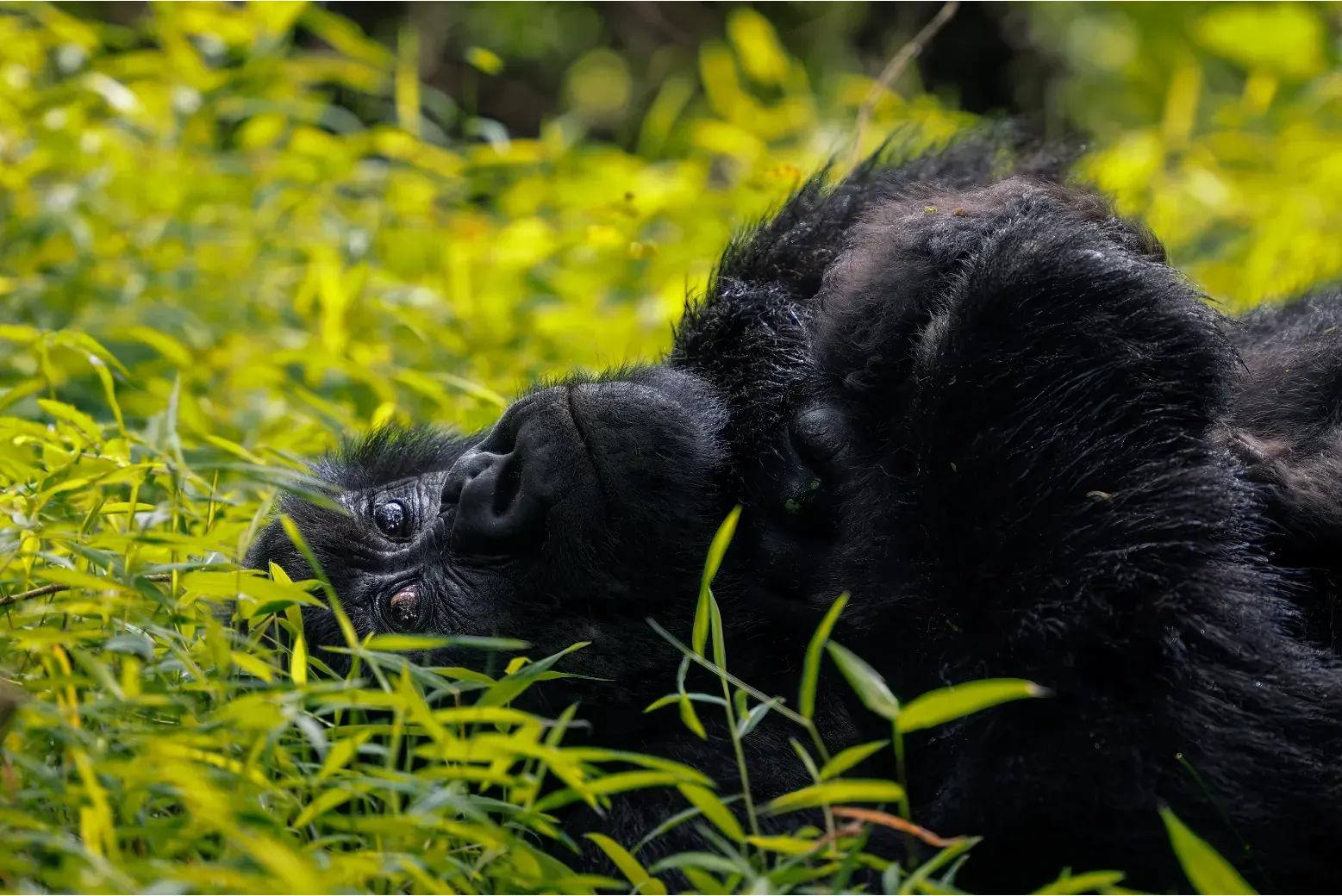
Gorilla trekking rules
Every rule here exists because mountain gorillas share enough of our biology to catch what we carry. They are not formalities and rangers enforce them.
Before you trek
Minimum age fifteen. Applied in both Uganda and Rwanda, checked at the park gate against your passport, and not negotiable. Families travelling with younger children should plan around this rather than hope.
Health screening. If you show symptoms of a cold, flu or any respiratory infection, you may be refused permission to trek. Gorillas are highly susceptible to human respiratory illness and an outbreak in a habituated family can be catastrophic. Refunds in this situation are handled under park policy, which we set out in writing with your booking.
Eight visitors per family per day. A hard cap in both countries. It is why permits are limited and why they need booking months ahead.
During the trek
Stay with your group and follow the ranger. Straightforward, and worth saying because the forest is disorienting and people wander to photograph things.
Keep your voice down. Both to avoid disturbing the family and because the trackers are listening for them.
Leave nothing behind. Everything you carry in comes out, including organic waste. If you need to relieve yourself, ask the ranger, who will dig a hole away from the trail.
With the gorillas
Seven metres distance. This is the core rule and the one visitors most often see broken — by the gorillas. Juveniles in particular approach out of curiosity. You are expected to move back rather than hold your ground for a better photograph.
One hour. From the moment the family is located. Rangers time it and there is no negotiation, however good the encounter.
No flash photography. Enforced. Set your camera before you set off, not while a silverback is watching you.
Do not eat, drink or smoke near the gorillas. Food is a disease vector and an attractant.
Stay low and avoid direct eye contact if a gorilla approaches or a silverback displays. Rangers will tell you what to do; do it immediately. Displays are almost always bluff, and the correct response is submissive rather than confrontational.
No flash, no drones, no exceptions. Drones are prohibited over the parks.
Why the rules are strict
Mountain gorillas number in the low thousands globally and every habituated family is individually significant. The regulations exist because a single human respiratory infection can move through a family quickly. The eight-person cap, the distance rule and the one-hour limit are all about reducing exposure, not about managing crowds.
Photography
Set your camera up before the trek. Flash off, and check it. Bwindi's canopy is dark, so favour a fast lens over a long one — at seven metres, reach is not your problem.
Spend part of the hour without the camera. Almost every trekker we take out says afterwards that the minutes they simply watched were the ones they remember.
Porters and tipping
Hiring a porter is not a rule but it is close to expected practice, and it is the mechanism by which trekking revenue reaches households around the park most directly. Many porters are former poachers or come from communities displaced when the parks were gazetted.
Tips for rangers, trackers and porters are customary and separate from your tour cost. We advise on current norms with your final documents rather than publishing figures that go stale.
Common questions
How close can you get to gorillas?
The regulation distance is seven metres. Gorillas, particularly juveniles, often come closer out of curiosity. Visitors are expected to move back rather than stay for a better photograph.
How long do you spend with the gorillas?
One hour, timed from when the family is located. It is strictly enforced in both Uganda and Rwanda.
Can I trek gorillas with a cold?
You may be refused permission. Gorillas are highly susceptible to human respiratory infections and rangers screen for symptoms before the trek.
Is flash photography allowed?
No. Flash is prohibited in both Uganda and Rwanda and the rule is enforced. Set your camera before you set off.
Plan your Kenya and gorilla safari
Tell us roughly when you want to travel and how long you have. We will send a written itinerary and a quotation.